
As many successful founders will tell you, college can be a powerful launchpad for starting your business. The right campus can connect you to your first mentor, deepen your expertise with business coursework, and connect you to alumni networks in a city where entrepreneurship is thriving.
A founder’s first big idea might start in a dorm room, a business class, a campus club, or a conversation with someone who sees the same gap in the market. Therefore, for aspiring entrepreneurs, choosing a college is not just about choosing the most prestigious business program.
With that in mind, Squarespace Domains analyzed US colleges and universities to identify the schools most likely to help produce the next generation of entrepreneurs and business leaders. The ranking considers factors such as business programs and concentrations, business school enrollment, graduation rates, post-graduate salaries, local new business formation, and local interest in starting a business.
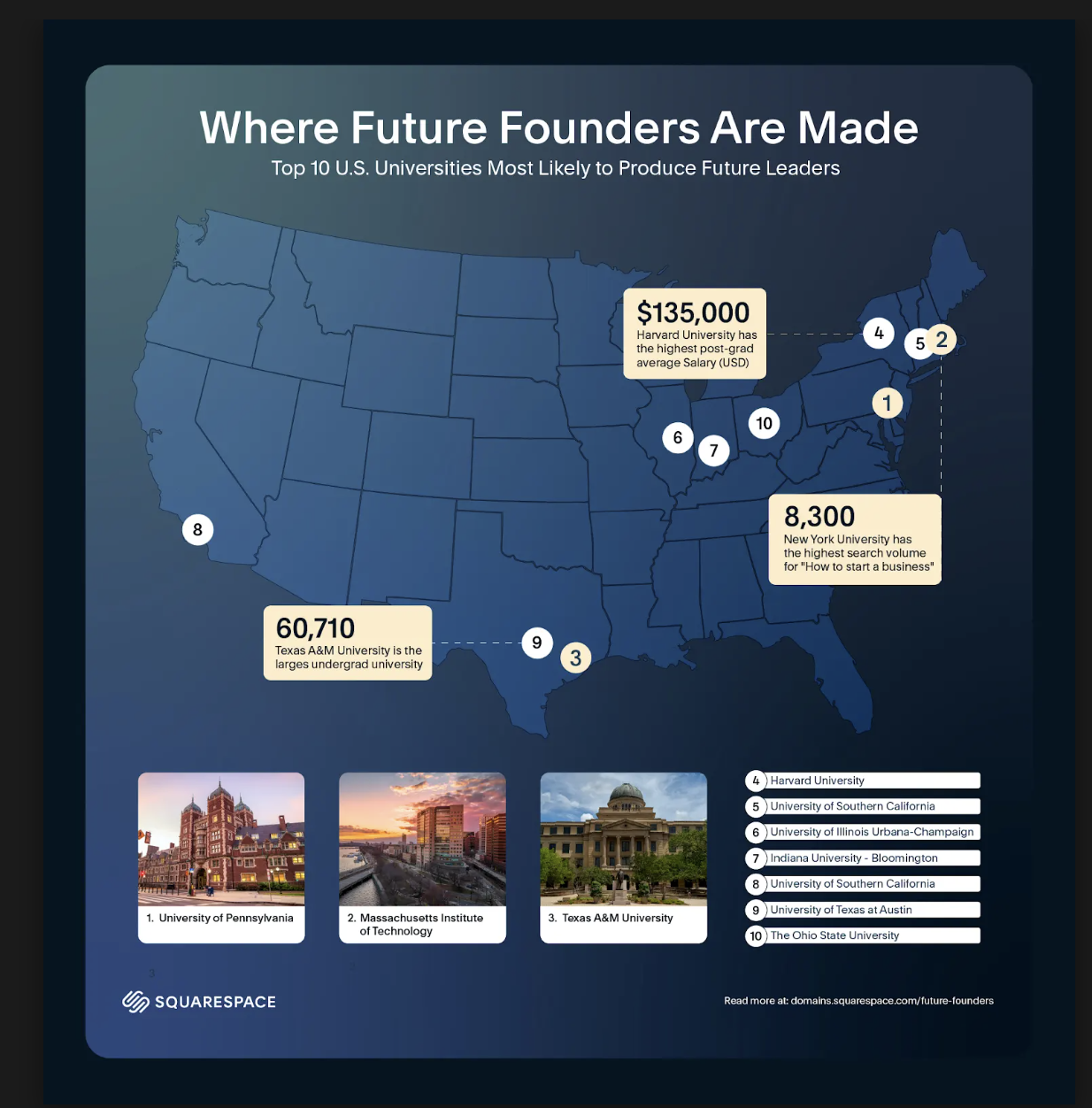
The Best US Colleges for Future Founders
1. University of Pennsylvania - Philadelphia, PA
The University of Pennsylvania takes the top spot as the best college for future founders. Penn stands out for its mix of strong academic outcomes, business education, and proven alumni success. The university has a 97% graduation rate, an average post-graduate salary of $125,000, and 22 undergraduate business concentrations, the highest number of business concentrations in the ranking.
Penn also counts 14 alumni on the 2025 Forbes 400 list, the third-highest alumni count in the study. Combined with its Philadelphia location, where the metro area saw 8,615 new businesses formed, Penn offers a strong mix of classroom preparation, alumni influence, and nearby business activity.
2. New York University - New York, NY
New York University ranks as the second-best college for future founders. NYU benefits from being located in one of the country’s most active business environments, with 36,868 new businesses formed in the New York metro area and the highest local search volume in the study for “how to start a business,” at 8,300 searches.
The university also offers 12 undergraduate business concentrations and has 5,951 students enrolled in its business school. With four undergraduate alumni represented on the 2025 Forbes 400 list, NYU combines a large student body, business-focused education, and direct access to one of the most entrepreneurial cities in the U.S.
3. Massachusetts Institute of Technology - Cambridge, MA
Massachusetts Institute of Technology ranks third among the best U.S. colleges for future founders. MIT’s strongest performance comes from its outcomes: the school has a 96% graduation rate and an average post-graduate salary of $120,000.
The university also counts five undergraduate alumni on the 2025 Forbes 400 list. Located in Cambridge, MIT benefits from the broader Boston-area business ecosystem, where 7,527 new businesses were formed. While MIT does not lead the ranking for business concentration volume, it performs strongly across the measures that signal long-term founder and business leader potential.
4. Harvard University - Cambridge, MA
Harvard University ranks fourth overall and leads the study for Forbes 400 representation, with 17 undergraduate alumni on the 2025 list. The university also has the highest graduation rate in the top 10 at 98%, along with one of the strongest average post-graduate salaries at $135,000.
Harvard’s ranking is especially interesting because it does not appear in the data as having an AACSB-accredited undergraduate business program. Its performance shows that future founder potential can come from more than traditional business coursework. Alumni networks, career outcomes, and institutional reputation can all play a role in shaping the path from student to business leader.
5. University of Southern California - Los Angeles, CA
The University of Southern California rounds out the top five. USC performs well across both school-level and city-level factors, with a 93% graduation rate, nine undergraduate business concentrations, and 6,988 business school students.
Its Los Angeles location also gives future founders access to one of the most active business environments in the ranking. The Los Angeles metro area saw 29,208 new businesses formed, while local search volume for “how to start a business” reached 4,480. USC also counts seven undergraduate alumni on the 2025 Forbes 400 list, tying it with several other high-performing schools in the study.
6. Cornell University - Ithaca, NY
Cornell University ranks sixth, supported by strong academic outcomes and a notable alumni record. The university has a 96% graduation rate, an average post-graduate salary of $113,000, and eight undergraduate alumni on the 2025 Forbes 400 list.
Cornell also offers 13 undergraduate business concentrations and has two business schools or programs counted in the data. While Ithaca is smaller than many of the metro areas represented in the top 10, Cornell’s school-level strengths help it remain one of the strongest colleges for future founders.
7. University of Texas at Austin - Austin, TX
The University of Texas at Austin ranks seventh, helped by its large student body, business programming, and location in one of the country’s most talked-about startup markets. The university has 10 undergraduate business concentrations, 6,601 business school students, and six undergraduate alumni on the 2025 Forbes 400 list.
Austin also adds to UT’s founder story, with 5,704 new businesses formed in the metro area and 2,840 local searches for “how to start a business.” Together, those factors suggest a strong mix of student scale, business interest, and local entrepreneurial momentum.
8. University of Illinois Urbana-Champaign - Champaign, IL
The University of Illinois Urbana-Champaign ranks eighth. The school has 12 undergraduate business concentrations, 8,924 business school students, and seven undergraduate alumni on the 2025 Forbes 400 list.
The university also has an 86% graduation rate and an average post-graduate salary of $80,000. While Champaign is not one of the largest metro areas in the study, the university’s business school enrollment and alumni performance help it stand out among future founder pipelines.
9. Texas A&M University - College Station, TX
Texas A&M University ranks ninth, showing how scale can help create future founder potential. It has the largest undergraduate enrollment among the top 10 schools, with 60,710 undergraduate students, as well as 6,448 business school students and eight undergraduate business concentrations.
The university also reports an average post-graduate salary of $99,000. Although Texas A&M does not have Forbes 400 alumni represented in the study, its size, business enrollment, and salary outcomes help it rank among the best schools for aspiring entrepreneurs.
10. Columbia University - New York, NY
Columbia University ranks 10th overall. Like NYU, Columbia benefits from being located in New York City, where the metro area saw 36,868 new businesses formed and local search volume for “how to start a business” reached 8,300.
At the school level, Columbia has a 93% graduation rate, an average post-graduate salary of $116,000, and five undergraduate alumni on the 2025 Forbes 400 list. Although Columbia is not counted as having an AACSB-accredited undergraduate business program in the dataset, its outcomes and location help make it one of the strongest schools for future founders.
What makes a university a strong launchpad for future founders?
A few patterns stand out:
Business education still matters: The University of Pennsylvania, University of Minnesota-Twin Cities, Indiana University Bloomington, and Northeastern University all rank among the schools with the most undergraduate business concentrations.
Location strengthens the founder pipeline: Schools in New York, Los Angeles, Boston/Cambridge, Austin, Washington, D.C., and Philadelphia benefit from strong local business activity and startup interest.
Alumni networks are a powerful tool: Harvard, Dartmouth, Penn, Princeton, Yale, Cornell, USC, UCLA, Stanford, and the University of Illinois Urbana-Champaign have some of the strongest Forbes 400 undergraduate alumni counts in the study.
For aspiring entrepreneurs, there is not one perfect school. Instead, the data shows there are many ways a university can support future founders, from formal business training to strong outcomes, large alumni networks, and a city full of people starting something new.
Name your next big idea something unforgettable
Whether you are planning a startup, opening a small business, launching a creative portfolio, or turning a side project into something more official, building a brand starts with choosing a name people can remember and find online.
A domain turns an idea into something real. Before the pitch deck, storefront, product launch, or first customer, a custom domain gives a founder a chance to claim the name for what they are building.
Methodology
To identify the US colleges and universities most likely to produce future entrepreneurs and business leaders, the Squarespace Domains team evaluated 100 institutions across several school-level and location-level factors. Metrics included Forbes 400 undergraduate alumni count, number of undergraduate business schools or programs, number of undergraduate business degree concentrations, business school enrollment, university graduation rate, post-graduate average salary, total undergraduate enrollment, search volume for “how to start a business” in the university’s designated city, and the number of new businesses formed in the university’s metro area.
Each metric was normalized and weighted to create an overall index ranking. Data sources included U.S. News, College Scorecard, AACSB, Forbes 400, institutional reporting, and campaign datasets for search volume and local business formation. Data is accurate as of May 11, 2026.
Forbes 400 alumni counts reflect the 2025 Forbes 400 list only and include only individuals who completed an undergraduate degree at the listed institution. Individuals who attended without graduating or attended exclusively at the graduate level were excluded. A school qualified as having a business program if it had an AACSB-accredited undergraduate business school or program; graduate-only programs were not counted. Business school enrollment figures are drawn from institutional reporting and may include graduate students where institutions do not report enrollment by level separately.